import numpy as np
import matplotlib.pyplot as plt
from einops import rearrange, repeat

import tensorflow as tf
from tensorflow.keras import layers
from tensorflow.keras.datasets import mnist

from flayers.layers import GaborLayerGabor layer experiment
In this quick experiment we will be training an MNIST classifier using
GaborLayer layers.
Library importing
Data loading
We will be using MNIST for a simple and quick test.
(X_train, Y_train), (X_test, Y_test) = mnist.load_data()

X_train = repeat(X_train, "b h w ->  b h w c", c=1)/255.0
X_test = repeat(X_test, "b h w ->  b h w c", c=1)/255.0

X_train.shape, Y_train.shape, X_test.shape, Y_test.shape
((60000, 28, 28, 1), (60000,), (10000, 28, 28, 1), (10000,))Definition of simple model
n_gabors = 4
sigma_i = [0.1, 0.2]*2
sigma_j = [0.2, 0.1]*2
freq = [10, 10]*2
theta = [0, np.pi/2]*2
rot_theta = [0, 0]*2
sigma_theta = [0, 0]*2
model = tf.keras.Sequential([
GaborLayer(n_gabors=n_gabors, size=20, imean=0.5, jmean=0.5, sigma_i=sigma_i, sigma_j=sigma_j, freq=freq,
theta=theta, rot_theta=rot_theta, sigma_theta=sigma_theta, fs=20, input_shape=(28,28,1)),
layers.MaxPool2D(2),
layers.GlobalAveragePooling2D(),
layers.Dense(10, activation="softmax")
])
model.compile(optimizer="adam",
loss="sparse_categorical_crossentropy",
metrics=["accuracy"])
model.summary()Model: "sequential_1"
_________________________________________________________________
Layer (type) Output Shape Param #
=================================================================
gabor_layer_1 (GaborLayer) (None, 28, 28, 4) 1626
_________________________________________________________________
max_pooling2d_1 (MaxPooling2 (None, 14, 14, 4) 0
_________________________________________________________________
global_average_pooling2d_1 ( (None, 4) 0
_________________________________________________________________
dense_1 (Dense) (None, 10) 50
=================================================================
Total params: 1,676
Trainable params: 76
Non-trainable params: 1,600
_________________________________________________________________We can show the initial Gabor filters:
model.layers[0].show_filters()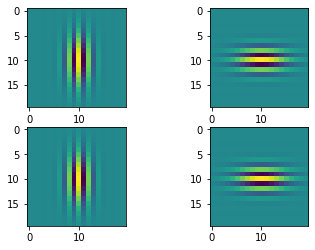
history = model.fit(X_train, Y_train, batch_size=128, epochs=1, validation_split=0.2)375/375 [==============================] - 17s 33ms/step - loss: 2.2897 - accuracy: 0.1481 - val_loss: 2.2693 - val_accuracy: 0.1996We can visualize the gabor filters after the training process:
model.layers[0].show_filters()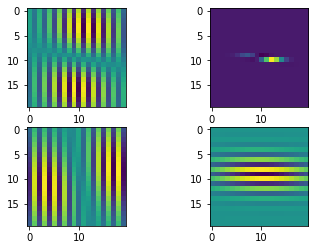
We can even check the atributes of the layer to inspect the change in the initial parameters:
model.layers[0].theta.numpy()*180/np.piarray([-1.3238928, 90.20859 , -2.235493 , 88.482956 ], dtype=float32)model.layers[0].rot_theta.numpy()*180/np.piarray([-1.3243861 , 0.27530777, 2.329611 , -1.5420123 ], dtype=float32)model.layers[0].sigma_theta.numpy()*180/np.piarray([-1.3520143, -4.6940336, 5.102634 , -1.5307682], dtype=float32)