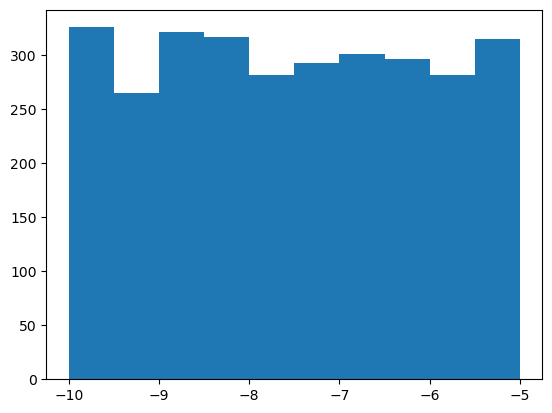
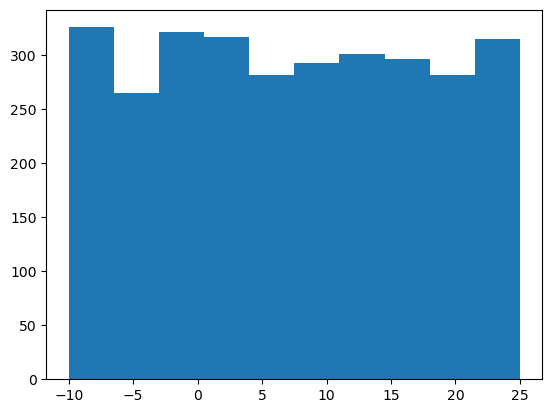
I found it weird that the flax library didn’t provide a “bounded” uniform initializer, so I took the code for the uniform one and modified it in a way that it allowed setting the bounds of the desired uniform initialization.
source
displaced_normal
displaced_normal (mean=0.0, stddev=0.01, dtype=<class 'numpy.float64'>)
Builds an initializer that returns real normally-distributed random arrays.
mean
float
0.0
Mean of the distribution.
stddev
float
0.01
Standard deviation of the distribution.
dtype
type
float64
Desired DType of the resulting array.
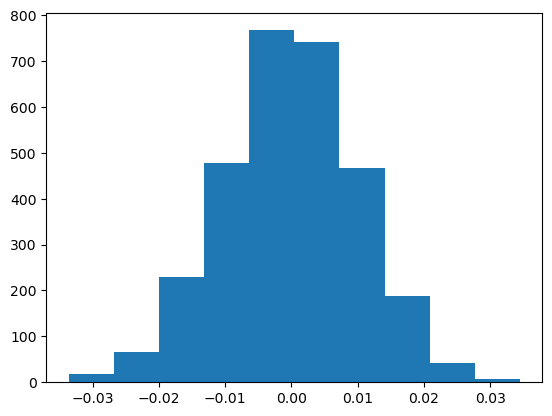
= nn.Dense(features= 1000 , kernel_init= displaced_normal())= layer.init(random.PRNGKey(0 ), jnp.ones(shape= (1 ,32 ,32 ,3 )))"params" ]["kernel" ].ravel())
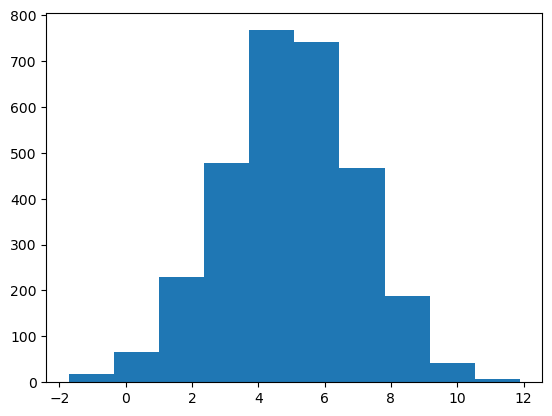
= nn.Dense(features= 1000 , kernel_init= displaced_normal(mean= 5. , stddev= 2. ))= layer.init(random.PRNGKey(0 ), jnp.ones(shape= (1 ,32 ,32 ,3 )))"params" ]["kernel" ].ravel())
source
freq_scales_init
freq_scales_init (n_scales, fs, dtype=<class 'numpy.float64'>)
n_scales
Number of scales.
fs
Sampling frequency.
dtype
type
float64
Desired DType of the resulting array.
= nn.Dense(features= 4 , kernel_init= freq_scales_init(n_scales= 4 , fs= 64 ))= layer.init(random.PRNGKey(0 ), jnp.ones(shape= (1 ,4 )))
FrozenDict({
    params: {
        kernel: Array([24., 12.,  6.,  3.], dtype=float32),
        bias: Array([0., 0., 0., 0.], dtype=float32),
    },
})
source
k_array
k_array (k, arr, dtype=<class 'numpy.float64'>)
k
Number of scales.
arr
Sampling frequency.
dtype
type
float64
Desired DType of the resulting array.
= nn.Dense(features= 4 , kernel_init= k_array(k= 2 , arr= jnp.array([24. , 12. , 6. , 3. ])))= layer.init(random.PRNGKey(0 ), jnp.ones(shape= (1 ,4 )))
FrozenDict({
    params: {
        kernel: Array([0.08333334, 0.16666667, 0.33333334, 0.6666667 ], dtype=float32),
        bias: Array([0., 0., 0., 0.], dtype=float32),
    },
})
source
log_k_array
log_k_array (k, arr, dtype=<class 'numpy.float64'>)
Initializer that generates the weights based on applying the log to a given array.
k
Number of scales.
arr
Sampling frequency.
dtype
type
float64
Desired DType of the resulting array.
= nn.Dense(features= 4 , kernel_init= log_k_array(k= 1 , arr= 1 / jnp.array([24. , 12. , 6. , 3. ])** 2 ))= layer.init(random.PRNGKey(0 ), jnp.ones(shape= (1 ,4 )))
FrozenDict({
    params: {
        kernel: Array([-6.3561077, -4.9698133, -3.583519 , -2.1972246], dtype=float32),
        bias: Array([0., 0., 0., 0.], dtype=float32),
    },
})
source
linspace
linspace (start, stop, num, dtype=<class 'numpy.float64'>)
start
stop
num
dtype
type
float64
Desired DType of the resulting array.
= nn.Dense(features= 4 , kernel_init= linspace(start= 0 , stop= jnp.pi, num= 4 ))= layer.init(random.PRNGKey(0 ), jnp.ones(shape= (1 ,4 )))
FrozenDict({
    params: {
        kernel: Array([0.       , 0.7853982, 1.5707964, 2.3561945], dtype=float32),
        bias: Array([0., 0., 0., 0.], dtype=float32),
    },
})
source
equal_to
equal_to (arr, dtype=<class 'numpy.float64'>)
arr
dtype
type
float64
Desired DType of the resulting array.
= nn.Dense(features= 4 , kernel_init= equal_to([1. , 2. , 3. , 4. ]))= layer.init(random.PRNGKey(0 ), jnp.ones(shape= (1 ,4 )))
FrozenDict({
    params: {
        kernel: Array([1., 2., 3., 4.], dtype=float32),
        bias: Array([0., 0., 0., 0.], dtype=float32),
    },
})
source
mean
mean (dtype=<class 'numpy.float64'>)
Builds an initializer that returns a kernel that calculates the mean of the interacting pixels.
dtype
type
float64
Desired DType of the resulting array.
= nn.Conv(features= 1 , kernel_size= (1 ,1 ), kernel_init= mean())= layer.init(random.PRNGKey(0 ), jnp.ones(shape= (1 ,32 ,32 ,3 )))"params" ]["kernel" ].ravel())